 Now accepting new patients - same-week appointments available!

"Is my testosterone normal for my age?" I hear this question weekly in my Brandon, Florida practice, usually from a man holding a lab printout and a phone full of contradictory internet answers. It is a fair question, and the honest answer is more nuanced than a single cutoff number: normal testosterone levels span a wide range, they decline gradually with age, and the number only tells half the story. The other half is how you feel.
Here is the frustrating part for patients: a total testosterone of 450 ng/dL might be perfectly healthy for one 55-year-old and represent a significant decline for another who used to sit at 800. Labs report one reference range for all adult men, guidelines use a single treatment threshold, and yet every man's hormonal baseline is his own.
In this article I will give you the actual numbers: typical total testosterone ranges by decade, what the roughly 1 percent per year decline really looks like, when a low number matters and when it does not, and who is genuinely a candidate for testosterone therapy. No hype, no fear-mongering, just what two decades of lab slips have taught me.

Table of Contents
- How Testosterone Changes Across a Man's Life
- Testosterone Levels by Age: The Reference Table
- Why Testosterone Declines About 1% Per Year
- Total vs. Free Testosterone: Which Number Matters?
- When a Low Number Matters (and When It Doesn't)
- Who Is Actually a Candidate for Testosterone Therapy?
- How to Protect Your Levels as You Age
- Common Mistakes I See in My Florida Practice
- Frequently Asked Questions (FAQ)
- Final Thoughts from a 20-Year FNP
How Testosterone Changes Across a Man's Life
Testosterone follows a predictable arc. It surges in adolescence, peaks in the late teens through the twenties, holds a broad plateau through the early thirties, and then begins a slow, steady descent of roughly 1 to 2 percent per year, a pattern documented in large studies like the Baltimore Longitudinal Study of Aging and the Massachusetts Male Aging Study.
Notice the word slow. Unlike menopause, which arrives as a defined transition for women, male hormonal decline is gradual. There is no cliff, which is exactly why so many men do not notice anything until their late 40s or 50s, when the cumulative drop finally crosses their personal symptom threshold.
Two men can follow very different curves, though. Lifestyle, body weight, sleep quality, chronic illness, and genetics all bend the slope. I have tested lean, active 60-year-olds at 650 ng/dL and 35-year-olds with obesity and sleep apnea at 280.
Testosterone Levels by Age: The Reference Table
The table below reflects typical total testosterone ranges for healthy men by decade, drawn from large population datasets and CDC-standardized laboratory reference work. Individual labs vary slightly in their reported ranges.
Age | Typical Total Testosterone (ng/dL) | What I Tell Patients |
20–29 | 400–1,080 | Lifetime peak; wide normal range |
30–39 | 350–1,010 | Plateau begins tapering late in decade |
40–49 | 330–950 | Decline becomes measurable; symptoms possible |
50–59 | 300–870 | Average man loses 100+ ng/dL vs. his 20s |
60–69 | 280–800 | Free testosterone falls faster than total |
70+ | 250–720 | Low levels common but still not automatic |
Three things to keep in mind when reading it:
First, these are population ranges, not personal targets. A man who peaked at 900 in his twenties and now sits at 400 has lost more than half his baseline, even though 400 is technically "in range."
Second, the lower boundary barely moves. That is deliberate: the diagnostic threshold for low testosterone stays around 300 ng/dL at every age, per the American Urological Association. Aging explains decline; it does not redefine deficiency.
Third, the ranges overlap enormously. Age alone never tells me whether a man's level is a problem. Symptoms do.

Why Testosterone Declines About 1% Per Year
The 1 percent per year figure is the most quoted number in men's health, and it is broadly accurate for total testosterone after age 30. But the decline is not purely a birthday phenomenon. It comes from three converging changes:
- The testes slow down. Leydig cells, which manufacture testosterone, gradually decrease in number and responsiveness.
- The brain's signal weakens. The hypothalamus and pituitary send less robust LH pulses, so the production order itself gets quieter.
- SHBG rises. Sex hormone-binding globulin, a protein that binds testosterone in the bloodstream, increases with age. More bound hormone means less free, biologically active testosterone. This is why free testosterone falls faster than total, often 2 to 3 percent per year.
Here is the encouraging part: research increasingly shows that a chunk of "age-related" decline is actually health-related decline. The European Male Aging Study found that weight gain and chronic illness accelerated hormonal decline far more than calendar age, and men who stayed lean and healthy showed remarkably modest drops. Age sets the trend; your health sets the slope.
Total vs. Free Testosterone: Which Number Matters?
Total testosterone measures everything in the bloodstream: the roughly 98 percent bound to SHBG and albumin, plus the 2 percent circulating free. Free testosterone is the fraction that actually enters cells and does the work.
For most men, total testosterone drawn in the morning is the right first test, and it is what the diagnostic guidelines are built on. Free testosterone earns its place when the total is borderline (say 250 to 350), when obesity or diabetes may be suppressing SHBG, or in older men whose rising SHBG can make a mediocre total look better than it functions. If your total is 480 but your SHBG is sky-high, you can still be functionally low, and this is exactly the situation where symptoms plus a full panel beat a single number.
When a Low Number Matters (and When It Doesn't)
This is the heart of the entire topic, so let me be plain: a number matters when it is genuinely low on repeat morning testing AND you have symptoms. Both. The Endocrine Society is explicit that hypogonadism is a clinical diagnosis requiring consistent symptoms plus unequivocally low levels on at least two separate morning draws.
A low number does not matter much when it is a one-off afternoon reading, when it was drawn during acute illness or severe sleep deprivation (both temporarily crater testosterone), or when a man feels completely well. I do not treat lab paper.
Conversely, symptoms without a low number deserve a wider search, not a testosterone prescription. Fatigue, low mood, and weight gain have a long differential: thyroid disease, anemia, depression, sleep apnea, vitamin deficiencies. If the symptom picture fits but your levels look fine, review the 12 signs of low testosterone and ask your provider what else could explain them.

Who Is Actually a Candidate for Testosterone Therapy?

Testosterone replacement therapy is appropriate for a specific, well-defined patient. In my practice, the checklist looks like this:
- Two low morning total testosterone results (generally under 300 ng/dL) on separate days, with free testosterone checked when the total is borderline.
- Consistent symptoms such as low libido, fatigue, muscle loss, or mood changes that meaningfully affect life.
- A cause evaluation. LH, FSH, prolactin when indicated, plus screening for reversible drivers like sleep apnea, obesity, and medication effects.
- No contraindications. Active prostate or breast cancer, an elevated hematocrit, untreated severe sleep apnea, a recent cardiac event, or plans for near-term fertility all change the conversation.
- A monitoring commitment. Labs at roughly 3 and 6 months, then ongoing, watching hematocrit, PSA, and symptom response.
Men who meet those criteria generally do well on therapy, and the evidence supports meaningful improvements in libido, energy, mood, bone density, and body composition. Men who do not meet them deserve the truth: therapy will not fix what low testosterone did not cause. At our men's health program in Brandon, the full workup comes before any prescription decision, every time.
How to Protect Your Levels as You Age
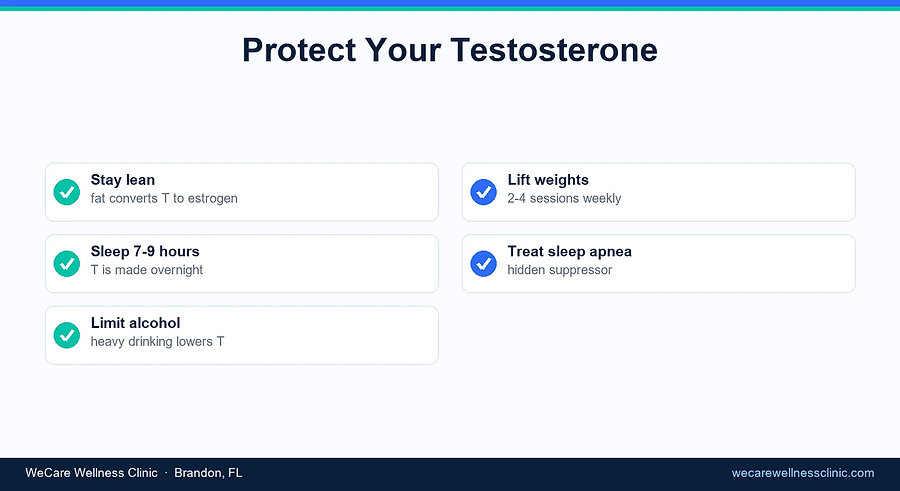
You cannot stop the calendar, but you can flatten the slope considerably:
- Stay lean. Excess fat tissue converts testosterone to estrogen. Maintaining a healthy weight is the single strongest lever.
- Lift weights. Resistance training two to four days weekly supports both testosterone and, more importantly, your body's sensitivity to it.
- Sleep 7 to 9 hours. Most daily testosterone production happens during sleep. Chronic short sleep can shave 10 to 15 percent off daytime levels.
- Treat sleep apnea. Untreated apnea is one of the most common hidden suppressors I find.
- Moderate alcohol. Regular heavy drinking measurably lowers production.
- Manage chronic conditions. Well-controlled blood sugar and blood pressure protect the whole hormonal axis.
Common Mistakes I See in My Florida Practice
Comparing your number to a friend's. The healthy range spans nearly a threefold difference. His 700 and your 500 can both be perfectly normal; trends within your own history matter far more.
Panicking over one borderline result. Testosterone fluctuates 15 percent or more day to day and drops sharply during illness or poor sleep. One low draw means one thing: repeat it in the morning.
Testing at the wrong time of day. Afternoon levels run 20 to 30 percent lower than morning. I still see afternoon lab slips used to sell therapy, and it is not acceptable practice.
Assuming decline is destiny. Men who address weight, sleep, and fitness often regain 100+ ng/dL naturally. Age-adjusted resignation leaves real health on the table.
Chasing a "peak twenties" number on therapy. The goal of treatment is the mid-normal range and symptom relief, not 1,000 ng/dL. Supraphysiologic levels raise risks without adding benefit.
Ignoring free testosterone in older men. Rising SHBG can hide a real deficiency behind a decent-looking total. When symptoms and totals disagree, check the free level.
Frequently Asked Questions (FAQ)
What is a normal testosterone level for my age?
For adult men, most labs consider roughly 300 to 1,000 ng/dL normal, with typical values around 400 to 1,080 in your 20s, 350 to 1,010 in your 30s, 330 to 950 in your 40s, and 300 to 870 in your 50s. The diagnostic cutoff for low testosterone stays near 300 ng/dL at every age.
Is 400 testosterone low for a 40-year-old?
No, 400 ng/dL is within the normal range for a 40-year-old, though it sits below average. Whether it matters depends on symptoms: if you feel well, no action is needed; if you have fatigue, low libido, or muscle loss, a free testosterone level and broader workup are reasonable next steps.
How fast does testosterone decline with age?
Total testosterone declines roughly 1 to 2 percent per year after about age 30, while free testosterone falls faster, closer to 2 to 3 percent per year, because binding proteins rise with age. Weight gain, poor sleep, and chronic illness can double that pace; staying lean and fit keeps the decline much shallower.
What is a dangerously low testosterone level?
There is no single "danger" number, but levels persistently below 200 ng/dL usually indicate significant hypogonadism and deserve a full evaluation, including pituitary hormones. Long-term untreated low testosterone increases risks of osteoporosis, anemia, and metabolic disease, so very low confirmed values warrant treatment discussion regardless of age.
Does testosterone decline cause "male menopause"?
Not in the way menopause happens to women. Male decline (sometimes called andropause) is gradual, about 1 percent per year, with no defined endpoint, and many older men keep normal levels for life. The Endocrine Society considers significant symptomatic deficiency a medical condition to diagnose, not an automatic stage of aging.
Can testosterone levels be too high?
Yes. Naturally high-normal levels are fine, but levels above roughly 1,000 to 1,100 ng/dL, usually from unsupervised therapy or steroid use, raise risks including thickened blood (elevated hematocrit), acne, mood swings, testicular shrinkage, and infertility. On monitored therapy, the target is the mid-normal range, not the maximum.
Should I get my testosterone checked every year?
If you are over 35 with symptoms, or you have diabetes, obesity, or sleep apnea, an annual morning testosterone level is reasonable and inexpensive to add to routine labs. Symptom-free men do not need routine screening under current guidelines, though a baseline in your 30s gives future results useful context.
At what testosterone level do doctors prescribe TRT?
Most guidelines, including the AUA's, support considering therapy when total testosterone is below 300 ng/dL on two separate morning tests and the patient has consistent symptoms. Borderline cases (300 to 400) with strong symptoms and low free testosterone are decided individually after a full evaluation of causes and risks.
Final Thoughts from a 20-Year FNP
If you take one thing from this article, make it this: your testosterone number is a data point, not a diagnosis, and "normal for your age" should never be used to dismiss real symptoms or to sell you treatment you do not need. I have seen both errors hurt men. The right approach is unglamorous: morning labs, repeated when low, interpreted next to how you actually feel, with the reversible causes addressed first and therapy reserved for men who truly need it.
If you are staring at a lab result and wondering what it means for you, bring it in. Book a visit at WeCare Wellness Clinic in Brandon and we will go through your numbers, your symptoms, and your options together, in plain English.
References
- American Urological Association: Evaluation and Management of Testosterone Deficiency
- Endocrine Society: Clinical Practice Guidelines
- NIH MedlinePlus: Testosterone Levels Test
- National Institute on Aging: Health Information
- CDC: Hormone Standardization Program

About the Author
Darlyne Georges, MSN, APRN, FNP-C, is a board-certified Family Nurse Practitioner based in Florida with over 20 years of clinical experience in primary care, chronic disease management, weight management, and metabolic health. She specializes in evidence-based, individualized care that combines lifestyle medicine, behavioral coaching, and (when appropriate) FDA-approved medical therapies.
Have questions about your health?
Same-week appointments available in-person or via Telehealth in Brandon, FL.
Book an Appointment →

