 Now accepting new patients - same-week appointments available!

IV hydration therapy has exploded in popularity over the past few years. Drip lounges are opening in strip malls, athletes swear by post-race infusions, and social media is full of people hooked up to colorful bags promising everything from glowing skin to instant immunity. As a nurse practitioner who has placed thousands of IVs across 20-plus years in primary care and critical care, I have a slightly unusual perspective: I love this therapy for the right patient, and I wince at some of the marketing.
So let's have an honest conversation. IV hydration therapy is genuinely excellent at what IVs have always been excellent at: restoring fluids, electrolytes, and specific nutrients quickly and reliably. For dehydration, documented vitamin deficiencies, migraine support, and recovery situations, the benefits are real and immediate. For some of the broader wellness claims, the evidence is more modest, and I'll tell you exactly where that line sits.
In this guide, I'll explain how IV therapy actually works, what's in the common formulations we use at our Brandon clinic, what a session feels like from check-in to finish, safety considerations, and who genuinely benefits, so you can decide whether it's right for you with clear eyes.

Table of Contents
- How IV Hydration Therapy Works
- What the Evidence Actually Supports
- Common IV Formulations Explained
- What Happens During a Session: A Walkthrough
- Who Benefits Most from IV Therapy?
- Is IV Therapy Safe? Risks and Who Should Skip It
- Common Mistakes I See in My Florida Practice
- Frequently Asked Questions (FAQ)
- Final Thoughts from a 20-Year FNP
- References
How IV Hydration Therapy Works
The concept is simple: fluids, electrolytes, and nutrients are delivered through a small catheter directly into a vein, bypassing your digestive system entirely. That bypass is the whole point, and it matters for two reasons.
First, speed. When you drink fluids, they move through your stomach and small intestine before reaching your bloodstream, a process that takes time and slows down dramatically when you're nauseated or your gut is irritated. IV fluids restore blood volume within 30 to 60 minutes.
Second, absorption. Oral vitamins are subject to the limits of your digestive tract. Vitamin C absorption, for example, drops significantly at higher oral doses because intestinal transporters saturate. B12 absorption depends on stomach acid and a protein called intrinsic factor, which is exactly why some people, especially older adults and those on acid-reducing medication, struggle to absorb it from food and pills. An IV or intramuscular route sidesteps all of that, achieving blood levels oral dosing can't match.
The base of nearly every drip is a sterile saline or balanced electrolyte solution, the same fluids used in every hospital in America. Vitamins and minerals are added to that base depending on the goal.
What the Evidence Actually Supports
Here's my honest, evidence-based breakdown, because you deserve better than marketing copy.
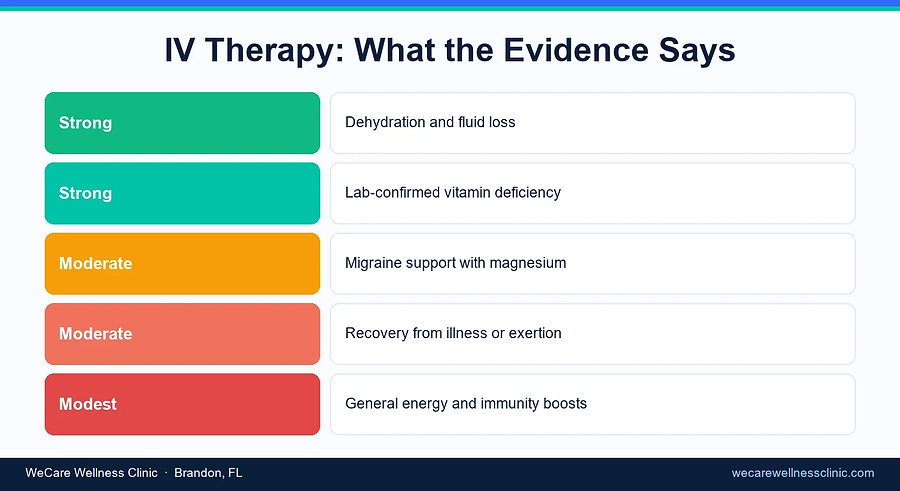
Strong evidence, clear benefit:
- Dehydration. This is settled medicine. IV fluids for moderate dehydration, whether from heat, illness, vomiting, or overexertion, work quickly and reliably. If you live here, Florida heat makes this scenario common; I covered the physiology in my Florida heat and dehydration survival guide.
- Documented deficiencies. If your labs show low B12, low iron (infusion in appropriate settings), or low magnesium, replacing the nutrient parenterally corrects the deficiency efficiently, particularly when absorption problems caused it in the first place.
- Migraine support. IV fluids with magnesium and anti-nausea support are used in emergency departments regularly, and controlled studies support IV magnesium for certain migraine types.
Moderate, situational evidence:
- Athletic recovery. Rehydration and electrolyte replacement after prolonged exertion is legitimate. Claims of enhanced performance beyond rehydration are thinner.
- Illness recovery. When a GI bug keeps you from holding fluids down, IV therapy shortens the misery. It supports recovery; it doesn't kill the virus.
Modest evidence, honest framing required:
- General wellness, energy, and immunity drips in people who are not deficient. If your B12 and vitamin C levels are normal, evidence that extra amounts through an IV produce lasting energy or immune benefits is limited. Some patients report feeling noticeably better, and part of that is real rehydration (most of us walk around mildly underhydrated), part may be placebo. I tell patients this plainly and let them decide.
That honesty matters to me. When a patient with normal labs asks whether a weekly vitamin drip will transform their energy, my answer is that we should first find out why they're tired, because fatigue has many medical causes worth actually diagnosing.
Common IV Formulations Explained
Every reputable clinic builds drips from a handful of core ingredients. Here's what they are and what they actually do:
Fluids and Electrolytes
Normal saline or lactated Ringer's solution, typically 500 to 1,000 mL. This is the workhorse: it restores blood volume, supports blood pressure, and rehydrates tissues. Sodium, chloride, and in balanced solutions potassium, calcium, and lactate come along with it.
B-Complex Vitamins
B1 (thiamine), B2, B3, B5, and B6 support the enzymatic machinery of energy metabolism. They're water-soluble, so what your body doesn't use is excreted. Most useful for people with poor intake, high alcohol use, or increased needs.
Vitamin B12
B12 supports red blood cell formation and nerve function. Deficiency is far more common than most people realize, particularly in adults over 50, vegetarians and vegans, and anyone on metformin or long-term acid reducers. Injected or infused B12 bypasses the absorption problems entirely. If you're perpetually exhausted, it's worth reading my piece on B12 deficiency as an overlooked fatigue cause, because this is one deficiency we can actually confirm with a blood test before treating.
Vitamin C
High-dose vitamin C achieves blood concentrations by IV that oral dosing cannot. It supports immune cell function and collagen synthesis. It's a reasonable addition during illness recovery; claims beyond that outpace the data.
Magnesium
My favorite underrated ingredient. Magnesium supports muscle relaxation, nerve conduction, and hundreds of enzyme systems, and IV magnesium has real evidence in migraine and muscle cramping. Many Americans run low on intake to begin with.
Zinc, Glutathione, and Add-Ons
Zinc plays a role in immune function. Glutathione is an antioxidant popular in wellness circles with more limited human outcome data. We'll always tell you which category an add-on falls into.
What Happens During a Session: A Walkthrough
Patients are often surprised by how uneventful and, frankly, pleasant a session is. Here's the play-by-play at our clinic:
- Health screening (10 minutes). We review your history, medications, allergies, and what brings you in. This step is non-negotiable; kidney disease, heart failure, and certain medications change what's safe to infuse. We check vital signs.
- Formulation selection. Based on your goals and health status, we choose the fluid base and additives. This is a clinical decision made with you, not a menu order taken blindly.
- IV placement (2 minutes). A small catheter, usually in the forearm or hand. A quick pinch, then most people forget it's there.
- The drip (30 to 60 minutes). You recline, read, scroll, nap, or work. Bring headphones if you like. Cold sensation in the arm is normal for the first few minutes. A brief metallic or vitamin taste can happen with B vitamins; it's harmless.
- Wrap-up. Catheter out, small bandage on, and you're free to drive and resume your day immediately. Most people feel the rehydration effect within a few hours.
Sessions at most Florida clinics range from roughly $100 to $300 depending on the formulation, with basic fluid-and-electrolyte drips at the lower end and multi-vitamin blends higher. IV therapy for wellness purposes is generally not covered by insurance, though medically indicated hydration during illness may be handled differently. We're transparent about pricing before anything starts; you can see what we offer on our IV hydration service page.

Who Benefits Most from IV Therapy?
Based on two decades of watching who actually walks out feeling dramatically better, these are the highest-value candidates:
- The dehydrated. Heat exposure, stomach bugs, food poisoning, travel, overexertion. Nothing rehydrates faster.
- People with confirmed deficiencies, especially B12 and magnesium, where absorption is part of the problem.
- Migraine sufferers whose attacks respond to fluids and magnesium.
- Athletes and outdoor workers needing rapid turnaround between demanding days in the Florida heat.
- Patients recovering from illness who can't yet eat and drink normally.
- Adults with absorption challenges, including those on long-term acid reducers or metformin and some post-surgical patients.
And who probably doesn't need it: a healthy, well-hydrated person with normal labs seeking a routine energy boost. I'd rather check your thyroid, iron, B12, vitamin D, and sleep first. That's just good medicine.
Is IV Therapy Safe? Risks and Who Should Skip It
In trained hands with proper screening, IV hydration therapy is very safe. The common side effects are minor: brief discomfort at the insertion site, a cold arm during infusion, occasional small bruise afterward. Infection at the site is rare with sterile technique.
The meaningful risks come from poor screening, which is why the intake step matters:
- Fluid overload. People with congestive heart failure or significant kidney disease can't handle rapid fluid volumes safely. These patients need medical supervision and often shouldn't receive elective drips at all.
- Electrolyte disturbances. Potassium and magnesium must be dosed thoughtfully, particularly with kidney impairment.
- Vein irritation. Certain additives, vitamin C in high doses among them, can irritate veins if infused too fast.
My advice: choose a clinic where a licensed medical provider reviews your health history, where ingredients and doses are disclosed, and where someone is authorized and equipped to manage a reaction. If a storefront hooks you up without asking about your kidneys or your medication list, walk out.

Common Mistakes I See in My Florida Practice
Using IV drips to avoid a diagnosis. If you need an infusion every week to feel human, the drip is masking something: anemia, thyroid disease, sleep apnea, depression, a deficiency we should document. Get labs first, then treat the actual problem.
Skipping the health screening. Patients sometimes get frustrated that we ask about kidneys, heart history, and medications before a "simple drip." That screening is what makes it a simple drip.
Expecting a hangover-proof body or bulletproof immunity. IV therapy rehydrates and replaces; it doesn't neutralize alcohol's damage or guarantee you won't catch the flu. Anyone promising that is selling, not treating.
Choosing on price alone. The cheapest drip in town matters a lot less than who is screening you, what exactly is in the bag, and who responds if something goes wrong.
Waiting until severe dehydration to act. Confusion, fainting, and minimal urination are emergency department territory, not drip lounge territory. Elective IV therapy is for mild to moderate situations.
Ignoring the oral basics. An IV once a month can't outwork a daily habit of two coffees, no water, and a salt-and-produce-free diet. The drip is a boost, not a substitute for drinking water.
Frequently Asked Questions (FAQ)
How long does IV hydration therapy take?
A typical session takes 45 to 60 minutes for the infusion itself, plus about 10 minutes of health screening beforehand. Smaller fluid volumes can run faster; larger bags or vein-sensitive additives like high-dose vitamin C run slower on purpose. Plan for about an hour and a quarter door to door, and you can drive yourself home afterward.
How much does IV hydration therapy cost?
Most IV hydration sessions in Florida cost between $100 and $300, depending on the formulation. Basic fluid and electrolyte drips sit at the lower end, while multi-vitamin blends with add-ons like glutathione run higher. Wellness infusions are typically not covered by insurance, so ask for transparent pricing up front. Reputable clinics will tell you the full cost before placing the IV.
Does IV therapy really work better than drinking water?
For speed and for anyone who can't keep fluids down, yes; IV fluids reach your bloodstream in 30 to 60 minutes without needing digestion. For routine mild dehydration in a healthy person, drinking water and electrolytes works nearly as well and costs nothing. The IV advantage is greatest with nausea, moderate dehydration, or absorption problems.
How often should you get IV hydration?
For most healthy people, only as needed: after significant dehydration, illness, or heavy exertion, which might mean a handful of times a year. Patients correcting a documented deficiency may follow a short scheduled series. If you feel you need weekly drips to function, that's a signal to investigate the underlying cause with labs rather than continuing to infuse.
Does getting an IV hurt?
Only briefly. IV placement feels like a quick pinch lasting a second or two, and most patients report no pain during the infusion itself. A cold sensation in the arm for the first few minutes is normal, and a small bruise afterward is possible. Experienced clinicians and good hydration beforehand make placement easier.
Can IV therapy cure a hangover?
It treats the dehydration and electrolyte loss that cause much of hangover misery, so many people feel substantially better within an hour. It does not reverse alcohol's inflammatory effects or protect your liver, and it isn't a green light to overdo it. Fluids, electrolytes, B vitamins, and anti-nausea support address symptoms; time does the rest.
Who should not get IV hydration therapy?
People with congestive heart failure, significant kidney disease, or uncontrolled blood pressure should avoid elective IV fluids unless their own provider supervises, because rapid volume can overload the heart and kidneys. Pregnant patients should get provider guidance first. This is exactly why a legitimate clinic screens your health history and medications before every infusion.
Are vitamin infusions safe?
Yes, when properly dosed and screened by a licensed provider; the vitamins used are water-soluble and excess is largely excreted. Risks arise with poor screening: fluid overload in heart or kidney disease, vein irritation from too-fast infusion, and electrolyte issues with kidney impairment. Ask what's in the bag, the doses, and who's supervising. Transparency is the safety signal.
Final Thoughts from a 20-Year FNP
I've placed IVs in emergency rooms, ICUs, and now in the much calmer setting of our Brandon clinic, and my respect for this simple therapy has never wavered. Fluids and electrolytes delivered directly to the bloodstream fix real problems fast. That's not a trend; that's a century of medicine. What has changed is the marketing around it, and my job is to help you sort the genuine benefits from the glitter.
If you're dehydrated, dragging after an illness, fighting migraines, or curious whether a deficiency is behind your fatigue, come talk to us. We'll screen you properly, check labs when they're warranted, and build a drip that matches your actual needs, or tell you honestly if you don't need one. You can book your visit at WeCare Wellness Clinic and we'll take great care of you.

References
- Centers for Disease Control and Prevention — Heat and Health
- NIH Office of Dietary Supplements — Vitamin B12 Fact Sheet for Health Professionals
- NIH Office of Dietary Supplements — Vitamin C Fact Sheet for Health Professionals
- NIH Office of Dietary Supplements — Magnesium Fact Sheet for Health Professionals
- National Institute of Diabetes and Digestive and Kidney Diseases — Health Information

About the Author
Darlyne Georges, MSN, APRN, FNP-C, is a board-certified Family Nurse Practitioner based in Florida with over 20 years of clinical experience in primary care, chronic disease management, weight management, and metabolic health. She specializes in evidence-based, individualized care that combines lifestyle medicine, behavioral coaching, and (when appropriate) FDA-approved medical therapies.
Have questions about your health?
Same-week appointments available in-person or via Telehealth in Brandon, FL.
Book an Appointment →

