 Now accepting new patients - same-week appointments available!

If I had a dollar for every patient who told me, "There's no way I'm low on vitamin D, I live in Florida," I could retire tomorrow. Yet week after week in my Brandon practice, the labs come back with the same finding: vitamin D deficiency, right here in the Sunshine State.
It feels like a contradiction. We have more than 240 sunny days a year in the Tampa Bay area. But look at how we actually live: air-conditioned cars, air-conditioned offices, quick walks through parking lots, and beach days properly covered in SPF 50. The sunshine is out there. Our skin just isn't meeting it.
In this article, I'll explain why vitamin D deficiency is so common in Florida, who is at highest risk, which symptoms should prompt a blood test, how to read your 25(OH)D result, and how we correct low levels safely. This is one of the most fixable problems I see in primary care.

Table of Contents
- The Florida Vitamin D Paradox
- What Vitamin D Actually Does in Your Body
- Who Is Most at Risk of Deficiency in Florida?
- Symptoms of Low Vitamin D
- How Vitamin D Testing Works: Understanding Your 25(OH)D Level
- How We Treat Vitamin D Deficiency
- Can You Get Enough from Sun and Food Alone?
- Common Mistakes I See in My Florida Practice
- Frequently Asked Questions (FAQ)
- Final Thoughts from a 20-Year FNP
- References
The Florida Vitamin D Paradox
Nationally, roughly one in three American adults has vitamin D below the range considered adequate for bone and overall health. You might expect Florida to be the exception. It isn't, and here's why.
We live indoors. From June through September, most Floridians treat the outdoors like a hallway between air-conditioned buildings. The hours when UVB rays are strong enough to make vitamin D (roughly 10 a.m. to 3 p.m.) are exactly the hours we avoid because of the heat.
We use sunscreen, as we should. Properly applied SPF 30 blocks about 97 percent of UVB radiation, the wavelength your skin needs to synthesize vitamin D. I will never tell a Florida patient to skip sunscreen; skin cancer is a far worse trade. But it means sun exposure isn't the reliable vitamin D source people assume.
Glass blocks UVB. Sitting by a sunny window or driving with the sun on your arm produces essentially no vitamin D.
So the paradox isn't really a paradox. It's modern life, and it's why testing matters more than assumptions.
What Vitamin D Actually Does in Your Body
Vitamin D behaves more like a hormone than a vitamin. Once your skin makes it or you swallow it, your liver and kidneys convert it into an active form that regulates calcium absorption, bone remodeling, muscle function, and immune signaling, with receptors in tissues throughout the body.
Adequate levels support bone density and reduce fracture risk, which matters enormously as we age. Low levels are associated with muscle weakness, and research continues on links to mood, immunity, and metabolic health. I'm careful not to oversell vitamin D as a cure-all, but correcting a true deficiency is foundational, and it pairs with the habits I cover in my guide to preparing for flu season.
Who Is Most at Risk of Deficiency in Florida?
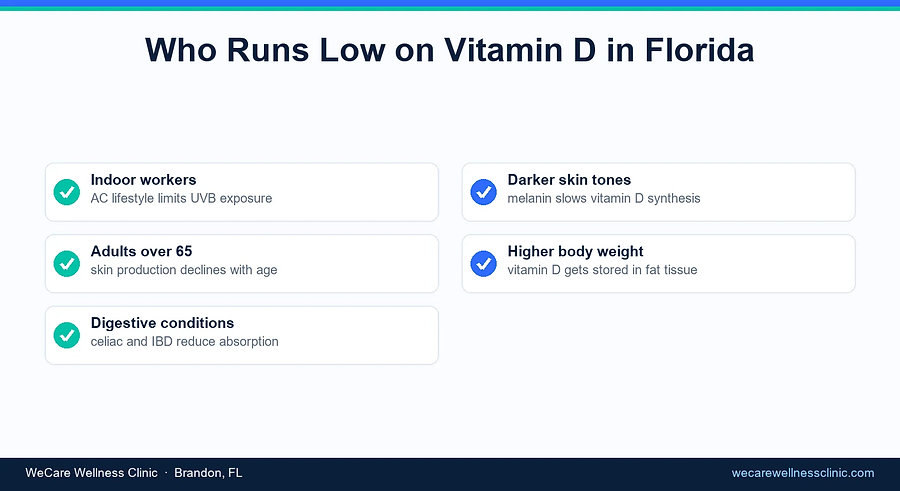
People with darker skin tones
Melanin is natural sun protection, and it also slows vitamin D synthesis: deeply pigmented skin may need several times more sun exposure to make the same amount of vitamin D as fair skin. National survey data consistently shows Black and Hispanic Americans have the highest rates of low vitamin D. In my practice, this is one of the most common, and most under-discussed, findings on routine labs for my patients of color.
Adults over 60
Aging skin produces vitamin D less efficiently. By your 70s, your skin may make about a quarter of what it made in your 20s from the same sun exposure, and older adults spend more time indoors.
People carrying extra weight
Vitamin D is fat-soluble, and excess body fat sequesters it out of circulation, so patients with obesity often need higher doses to reach the same blood level.
Indoor workers and night-shift workers
Nurses, warehouse staff, office workers, night-shift hospitality workers: if your waking daylight hours happen under a roof, your risk goes up.
People with digestive or kidney conditions
Celiac disease, Crohn's disease, gastric bypass surgery, and chronic kidney or liver disease all interfere with absorbing or activating vitamin D, and some medications, including certain seizure drugs and steroids, accelerate its breakdown.
Symptoms of Low Vitamin D
Here's the honest truth: mild deficiency is often silent, which is exactly why it hides for years. When symptoms show up, the ones I see most are:
- Persistent fatigue and low energy
- Muscle aches, cramps, or weakness
- Bone pain or deep aching in the lower back, hips, or legs
- Frequent colds or slow recovery from illness
- Low mood, particularly a heavy, flat tiredness
- Hair shedding in some patients
None of these symptoms are specific to vitamin D. Fatigue alone has a long list of causes, which I walk through in my article on the medical causes of fatigue. That's why I test rather than guess: my fatigue workup usually includes vitamin D alongside thyroid, blood count, metabolic panel, and often a B12 level, another fatigue cause that's routinely missed.
How Vitamin D Testing Works: Understanding Your 25(OH)D Level

The right test is serum 25-hydroxyvitamin D, written as 25(OH)D, which reflects your total stores from sun, food, and supplements. Here's how I interpret results, drawing on Endocrine Society and NIH guidance:
- Below 20 ng/mL: deficient. Needs treatment, not a casual supplement.
- 20 to 29 ng/mL: insufficient. Suboptimal, especially for bone health; I typically recommend supplementation.
- 30 to 50 ng/mL: sufficient. My target zone for most patients.
- Above 100 ng/mL: potentially harmful. Toxicity is rare and comes from high-dose supplements, not sun.
One nuance: expert bodies draw the "adequate" line differently, with the National Academy of Medicine accepting 20 ng/mL for bone health while the Endocrine Society has favored 30 for at-risk patients. In practice, I aim for 30 to 50 in symptomatic patients and follow the trend. Testing is a simple blood draw we run with comprehensive labs at our primary care practice in Brandon, with a recheck about 12 weeks after starting treatment.
How We Treat Vitamin D Deficiency
Treatment depends on how low you are, and why.
For true deficiency (below 20 ng/mL): a common evidence-based approach is 50,000 IU of vitamin D2 or D3 once weekly for 8 to 12 weeks, or roughly 6,000 IU daily, followed by a maintenance dose once the level normalizes.
For insufficiency (20 to 29 ng/mL): daily vitamin D3 at 1,000 to 2,000 IU usually does the job over a few months.
For maintenance: most adults hold a healthy level with 1,000 to 2,000 IU of D3 daily. The RDA is 600 to 800 IU, but many of my Florida patients need more to stay in range. The safe upper limit for ongoing daily intake is 4,000 IU unless your provider directs otherwise.
Three practical tips: take vitamin D with a meal containing some fat, since it absorbs better; choose D3 (cholecalciferol) over D2 when you have the option; and recheck your level rather than assuming the dose worked. Patients with obesity or absorption issues often need adjusted dosing, a conversation for your provider.

Can You Get Enough from Sun and Food Alone?
Sometimes, but rarely reliably. Sensible, incidental sun exposure (10 to 20 minutes on arms and legs a few times weekly, outside peak burn hours) contributes meaningfully for fair-skinned people, less so for darker skin tones. I never recommend intentional tanning; the skin cancer math never works in your favor in Florida.
Food helps but rarely carries the load. The best sources are fatty fish, fortified milk and juice, egg yolks, and UV-exposed mushrooms. A serving of salmon provides roughly 400 to 600 IU; a cup of fortified milk about 120 IU. If you're deficient, food alone will almost never correct it. That's why test, supplement, retest is the strategy I use.
Common Mistakes I See in My Florida Practice
Assuming the zip code protects you. Living at latitude 27 does nothing if your UVB exposure happens through a windshield. Deficiency shows up in Floridians of every lifestyle.
Supplementing blindly without a baseline test. Some patients take 400 IU when they need a correction dose; others take 10,000 IU daily for years unmonitored. Test first, dose to target, retest.
Taking vitamin D on an empty stomach. It's fat-soluble. Taken with black coffee and nothing else, much of it passes right through you.
Stopping the supplement once you feel better. Your level will drift back down within months if the underlying habits haven't changed. Treatment transitions to a maintenance dose, not to nothing.
Chasing sky-high levels. Above roughly 100 ng/mL, vitamin D can raise blood calcium and cause nausea, kidney stones, and worse. I've seen patients on stacked supplements land there without realizing it.
Ignoring the "why." If your level won't budge on appropriate dosing, that's a clue: absorption problems, medication interactions, or dosing that doesn't fit your body. That deserves a workup, not a bigger bottle.
Frequently Asked Questions (FAQ)
Can you really be vitamin D deficient in Florida?
Yes, vitamin D deficiency is common in Florida despite abundant sunshine. Indoor air-conditioned lifestyles, consistent sunscreen use, and UVB-blocking glass mean most residents get far less skin synthesis than the weather suggests. Risk rises with darker skin tones, age over 60, higher body weight, and indoor work. In my Brandon practice, low vitamin D is one of the most frequent abnormal results on routine labs.
What level of vitamin D is considered deficient?
A 25(OH)D level below 20 ng/mL is deficient, and 20 to 29 ng/mL is insufficient. Most clinicians, including me, target 30 to 50 ng/mL for patients with symptoms or bone-health risk factors. Levels above 100 ng/mL can become harmful, so high-dose supplementation should always be monitored with follow-up labs.
What are the most common symptoms of low vitamin D?
Fatigue, muscle aches or weakness, bone pain, frequent infections, and low mood are the most common symptoms of low vitamin D. Mild deficiency is often silent, which is why it's usually discovered on blood work. Because these complaints overlap with thyroid disease, anemia, and B12 deficiency, testing is the only reliable way to know.
How much vitamin D should I take daily?
Most adults maintain healthy levels with 1,000 to 2,000 IU of vitamin D3 daily, while correcting a true deficiency often requires 50,000 IU weekly for 8 to 12 weeks under provider guidance. The RDA is 600 to 800 IU, but many people need more. Don't exceed 4,000 IU daily long term without medical supervision.
How long does it take to fix a vitamin D deficiency?
Most deficiencies correct within 8 to 12 weeks on appropriate treatment dosing. Blood levels rise gradually, so I recheck the 25(OH)D level about three months after starting. Energy and muscle symptoms often improve over several weeks. After correction, a daily maintenance dose keeps you from sliding back.
Is it better to get vitamin D from the sun or supplements?
Supplements are the more reliable and safer option for correcting low vitamin D, especially in Florida where unprotected midday sun raises skin cancer risk. Brief incidental sun exposure contributes, but sunscreen, glass, and indoor living make it inconsistent. Keep your sun protection habits and use vitamin D3 supplementation guided by lab testing.
Can too much vitamin D be dangerous?
Yes, vitamin D toxicity is real, though rare, and it comes from supplements rather than sunshine. Sustained very high intakes can push blood levels above 100 ng/mL, raising calcium and causing nausea, confusion, kidney stones, and kidney damage. This is why I test before dosing and monitor anyone on high-dose therapy.
Does vitamin D help your immune system?
Vitamin D plays a documented role in immune function, and correcting a deficiency supports normal immune defenses. Immune cells carry vitamin D receptors, and low levels are associated with more frequent respiratory infections. Taking extra vitamin D when your level is already sufficient hasn't been shown to add protection, so the goal is adequacy, not megadoses.
Final Thoughts from a 20-Year FNP
After two decades in healthcare, I've learned that the most satisfying problems to treat are the ones hiding in plain sight, and low vitamin D in Florida is exactly that. Patients arrive convinced their exhaustion is just age or stress, and three months after we correct a deficiency, they tell me they'd forgotten what normal energy felt like. The test is simple, the fix is inexpensive, and the downside of not knowing is years of feeling less than your best.
If you're tired, achy, getting sick often, or simply haven't had labs in over a year, let's find out where you stand. A vitamin D level is part of the comprehensive blood work we run at WeCare Wellness Clinic in Brandon. Book an appointment online or call 813-438-5220. The sunshine is free, but knowing your numbers is what actually protects you.

References
- National Institutes of Health, Office of Dietary Supplements: Vitamin D Fact Sheet for Health Professionals
- Endocrine Society: Vitamin D and Health Resources
- Centers for Disease Control and Prevention: Nutrition Reports and Vitamin D Status Data
- MedlinePlus: Vitamin D Test
- American Academy of Dermatology: Sun Protection Guidance

About the Author
Darlyne Georges, MSN, APRN, FNP-C, is a board-certified Family Nurse Practitioner based in Florida with over 20 years of clinical experience in primary care, chronic disease management, weight management, and metabolic health. She specializes in evidence-based, individualized care that combines lifestyle medicine, behavioral coaching, and (when appropriate) FDA-approved medical therapies.
Have questions about your health?
Same-week appointments available in-person or via Telehealth in Brandon, FL.
Book an Appointment →

